

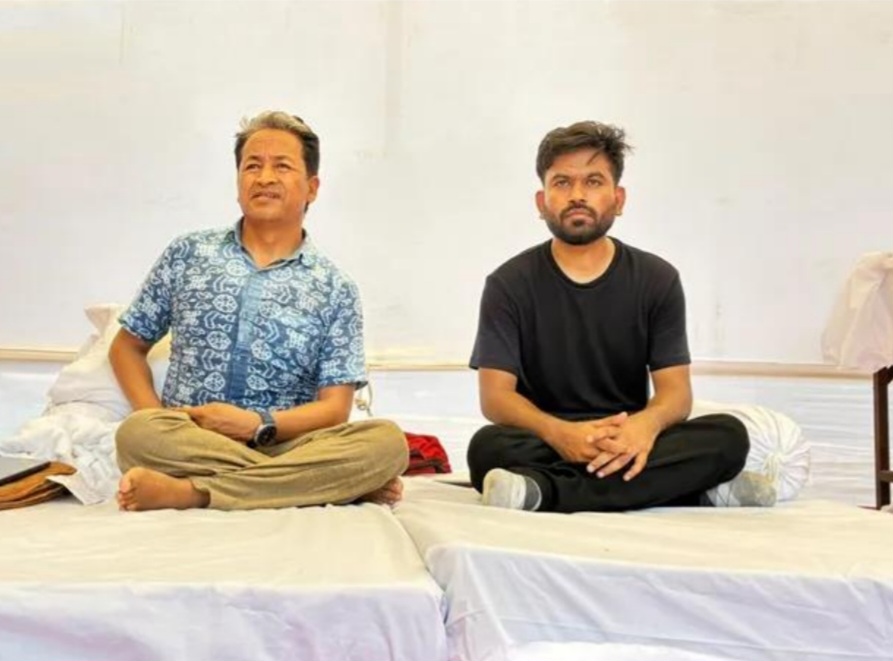
New Delhi (By Subham Bose): Renowned education reformer, engineer and climate activist Sonam Wangchuk joined the ongoing protest led by the Confederation of Job
Associations of Punjab (CJP) at Jantar Mantar in New Delhi, launching an indefinite hunger strike in solidarity with demonstrators demanding a fair and
transparent approach to the proposed delimitation exercise.
Wangchuk’s participation has drawn national attention to the agitation, which
has been gathering momentum over concerns that the upcoming delimitation of parliamentary constituencies could disproportionately affect states that have successfully implemented population control measures. Protesters argue that
any redistribution of Lok Sabha seats based solely on population figures could reduce the political representation of several states while rewarding those with higher population growth.
Addressing supporters shortly before beginning his fast, Wangchuk stressed that the issue extends far beyond electoral boundaries. He described delimitation as a matter that would shape India’s democratic structure for decades and urged
policymakers to ensure that any exercise upholds the constitutional principles of
fairness, equality and national unity.
He appealed to the Union government to engage in wider consultations with
state governments, constitutional experts and civil society organisations before
finalising any framework for the delimitation process. According to Wangchuk,
decisions of such national significance should emerge from consensus rather
than political expediency.
The hunger strike began at Jantar Mantar, a traditional venue for public
demonstrations in the national capital, where hundreds of supporters, student
groups, social activists and representatives of various organisations gathered to
express solidarity. Many participants carried placards calling for equitable
representation and protection of the federal balance envisioned in the
Constitution.
The Confederation of Job Associations of Punjab, which has been spearheading
the protest, stated that its concerns revolve around preserving the voice of states
that have made significant progress in education, healthcare and family
planning. The organisation maintains that representation in Parliament should
not become a disincentive for states that have successfully managed population
growth through sustained policy efforts.
Several speakers at the gathering argued that demographic trends alone should
not determine parliamentary representation, contending that factors such as
governance performance, development indicators and federal equity also
deserve consideration. Protesters called upon the Centre to build political
consensus before undertaking any constitutional exercise related to delimitation.
The issue has become increasingly significant as discussions surrounding the
next delimitation exercise continue to generate debate across the country. Under
constitutional provisions, the delimitation of parliamentary and assembly
constituencies has remained frozen for several decades to encourage states to
pursue population stabilisation measures. The freeze is scheduled to end after
the first Census conducted following the prescribed constitutional timeline,
making the forthcoming exercise politically sensitive.
Political observers note that the debate has triggered concerns in several
southern and northern states that have experienced lower population growth
rates. Leaders from these regions have repeatedly argued that they should not
face diminished parliamentary influence for successfully implementing family
planning initiatives. On the other hand, some leaders maintain that
parliamentary representation must continue to reflect changing demographic
realities to ensure equal representation for citizens.
Wangchuk urged citizens to view the debate through the lens of national interest
rather than regional divisions. He emphasised that India’s democratic strength
lies in balancing the principles of population-based representation with the
country’s federal character, ensuring that no region feels disadvantaged.
The activist also called for peaceful and democratic engagement, encouraging
people from across the country to participate in informed discussions on the
subject. He reiterated that his hunger strike was intended as a non-violent appeal
to policymakers to protect constitutional values and promote dialogue.
As the protest continues at Jantar Mantar, organisers have indicated that
demonstrations will persist until the government provides assurances regarding
wider consultations on the delimitation process. Security arrangements in the
area have been strengthened, while authorities continue to monitor the situation.
With Wangchuk’s entry into the movement lending greater visibility to the
campaign, the protest has evolved into a broader discussion on representation,
federalism and the future of India’s democratic institutions. Whether the
demonstrations translate into formal policy discussions remains to be seen, but
the issue has undoubtedly emerged as one of the country’s most closely watched
constitutional debates.