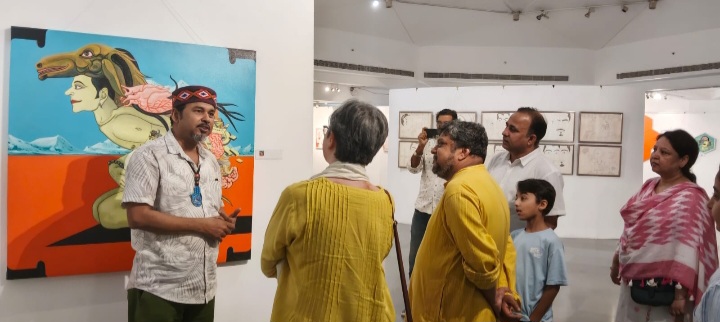

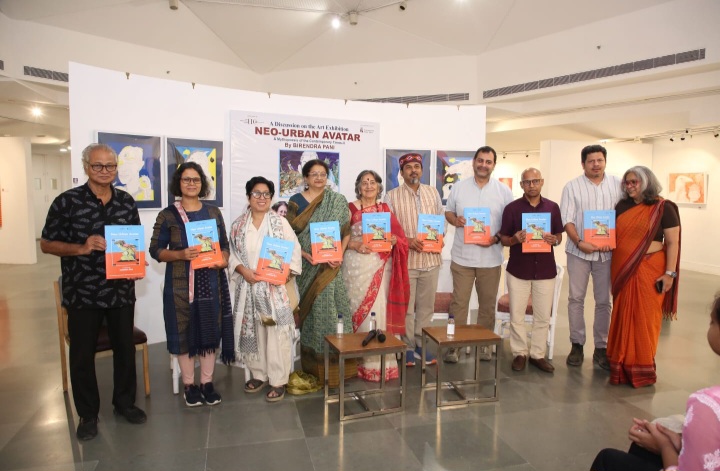
New Delhi / Bhubaneswar : An important art exhibition titled Neo-Urban Avatar: A Mythopoesis of the Contemporary Times-II, the 16th solo art exhibition by Birendra Pani was held at the India International Centre, New Delhi from July 1 to 14, 2026 organised by the India International Centre, New Delhi in collaboration with Purushottam Public Trust, New Delhi.
The exhibition was visited by a large crowd during these days and his contemporary visual language much admired by renowned figures fromthe art fraternities like Geeta Kapur, Prof. Parul Dave Mukherji, Prof. Shukla Sawant, Prof. Y. S Alone, Dr. Alka Pande, Ravi Agarwal, Inder Salim, Jagannath Panda, Savi Sawarkar and others and Ex-Diplomat Lalit Mansingh, K. N. Shrivastav, Director, IIC, Dr. K. G Suresh, Director, India Habitat Centre, and many other important dignitaries and friends, visitors from different disciplines which was remarkable in itself.
This exhibition, with the title ‘neo-urban avatar’ envisages a new kind of ‘avatar’ or ‘transformation of self’ to bring about a positive change amidst the looming concerns in the present time due to excessive urbanisation, ecological crises and negligence of local culture.
It showcased 80 art works in five sections, fromdifferent phases of 35 years of Birendra Pani’s artistic journey. The Day Dreaming in Vadodara Series (1997-2002) of serigraphy-based prints, contains work like Day dreaming in Vadodara, the Super Hero, the Fundamental Fulmination, the Evening cream- I & II, The Last temptation of Buddha, The Floating Heart, Paper Flower for your Sweet Heart, and other works foregrounding the concerns related to hyperurbanism, materialist and consumer instincts in everyday life which the artist encountered in Vadodara in late 1990s.
Elements like capsule, heart, brain are the important visual ‘metaphors’, and kitsch, popular imageries and satire has been important elements of his art works.
The other works from the 365 Days Drawing Series (2010-2012) include fine drawing-based images showing “man whose heart is full of capsule; man eating and thriving majorly on capsules and without internal strength; man eating objects, capsules as the external stimulus for love, emotion, feeling for happiness; man women completely immersed in materialist consumerist culture” and other works. ‘Capsule’-here is a metaphor of excessive consumerist tendency in everyday life.
The Handmade Memory Series, and Sanguine Story Series reflects (2016-2026) hyper urbanismbut incorporating elements frommythological experiences, memory of the local culture, including elements of satire, and reimagining a new relationship with naturefor a new narrative of change.
The Urban Avatar Series (2020) of intricate drawing-based paintings works on canvas are derived from his everyday life experiences during his stay in San Diego.
The “Neo-Urban Avatar-A Mythopoesis of the Contemporary Times Series” (2024-2026) showcased art works in a globalized and technologized visual culture yet rooted in Indian aesthetic traditions, especially the Patta Chitraand palmleaf drawings, the monumental architectural and sculptural tradition, folk and performance tradition, and popular art of his native state of Odisha, Birendra Pani’s vibrant, colourful, and drawing based art works focus on unwarranted urbanism, consumerism, and negligence of the local culture in the present time.
Taking reference from the mythological narrative of Dasavatara, the images are embedded with the hexagons- the conceptual and visual metaphor for the concrete jungle, in our present. The Neo-Urban Avatar paintings referring Meena Avatar is shown with water in a dark atmosphere and in a grided sky rather than the open sky; the Varaha Avatar entrapped within the sky scrapers and the hexagonal structures and other depictions, the Haladhar Avatar invites a new connection with soil and nature and other depictions. Here, the central character in the narrative is the ‘self’ rather than the mythical or the sacred, to bring about a positive change in the contemporary life, in the face of the imminent ecological concerns, negligence of the local culture and relentless consumerism.
The melting clock symbolizes the first changing present time which is uncertain and unpredictable, yet anticipating a positive time in future.
The climax image Viswa Roopam Returns-1 depicts a surrealist atmosphere with the glacier mountain is in a distant horizon; the human protagonist juxtaposed with an imaginary animal resembling the Neel Gai and Varaha; and the material objects like aeroplane, buildings, structures, heart, brain, history and other elements are falling down as the avatar is moving forward. Akin to the Viswa Avatar countering human limitation, here, the depiction counters human materialist ego.
Along with art historian Dr. Rajashree Biswal, Birendra Pani is involved in various art and cultural activities through their cultural initiative New Bride India, to create a new cultural sensibility and awareness among the youth and the larger public.
With his 16 solo art exhibitions in New York, San Diego, California, Kuala Lumpur, and in different parts of India; and in more than 350 group art exhibitions across the globe, the artist has received accolades from the Ministry of Human Resource Development, Government of India; South Central Zone Cultural Centre, Nagpur; Odisha State Lalit Kala Academy Awards and other awards.