

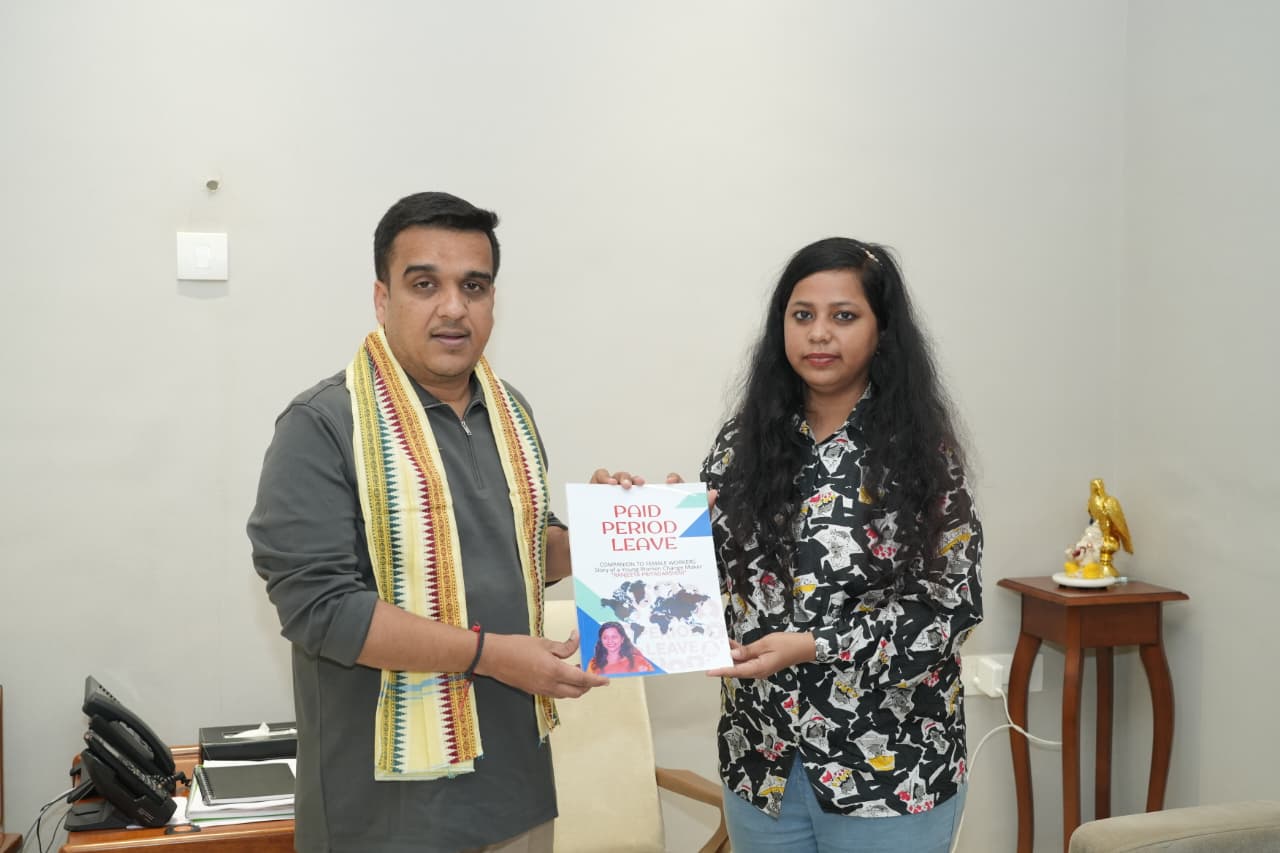
Bhubaneswar : After eighteen months of unwavering persistence, social entrepreneur and paid‑menstrual‑leave campaigner Ranjeeta Priyadarshini reached a milestone in Surat when she submitted a formal memorandum to Gujarat Deputy Chief Minister Harsh Sanghavi, urging the state government to implement Paid Period Leave for women employees across both private and government sectors.
Her journey in Gujarat began in March 2025, when she first travelled to Surat with the same demand, laying the groundwork for what would become a sustained and determined push. That initial step marked the beginning of a longer conversation, once she was committed to pursuing until the state was ready to listen. She met with Mukesh Dalal, the MP for Surat, has been involved in discussions regarding paid period leave. further, MLA Mannu Bhai Patel and met industrialist, philanthropist, and Padma Shri awardee Mathur Madhabhai Savani, Chairman of Kiran Hospital, Surat, publicly extended his support and requested to implement Paid Period Leave. Over the following year and a half, she continued to build her case, engaging leaders, employers, and civil society voices across India while steadily working toward this moment.
On September 2, 2026, her campaign gained significant local momentum when noted industrialist, philanthropist, Mahesh Bhai Savani, publicly extended his support. His endorsement added weight within Gujarat’s influential business community, signalling that the demand resonated beyond activists. He is widely known for funding and organizing mass wedding ceremonies for over 5,000 fatherless brides across various faiths
The following day, Ranjeeta’s along with Advocate Jagdish Sethy from Surat, long‑awaited meeting finally materialised. She formally submitted her memorandum to Deputy Chief Minister Harsh Sanghavi, appealing for a state policy mandating Paid Period Leave as a matter of health, dignity, and equity in the workplace.
Ranjeeta’s path to this point has been shaped by persistence. A former engineer and HR welfare officer who later trained as a lawyer, she left her job to found the Paid Period Leave campaign after experiencing firsthand the absence of menstrual leave in workplaces. Her advocacy has since taken her from state assemblies to international platforms, including the United Nations Civil Society Conference in Nairobi, and has already led to adoption of Paid Period Leave by more than two dozen private organisations, alongside a landmark government announcement in Odisha, Karnataka and Bihar.
The Gujarat chapter stands out because it reflects the strength of persistence — a campaigner who returned better supported and better prepared, ultimately securing a seat at the table with Gujarat’s leadership. If Gujarat acts on this memorandum, it would mark another major state‑level victory for the movement, reinforcing the growing national conversation on menstrual health as a workplace and policy issue, and adding momentum to Ranjeeta’s campaign one state, one company, and one meeting at a time.