

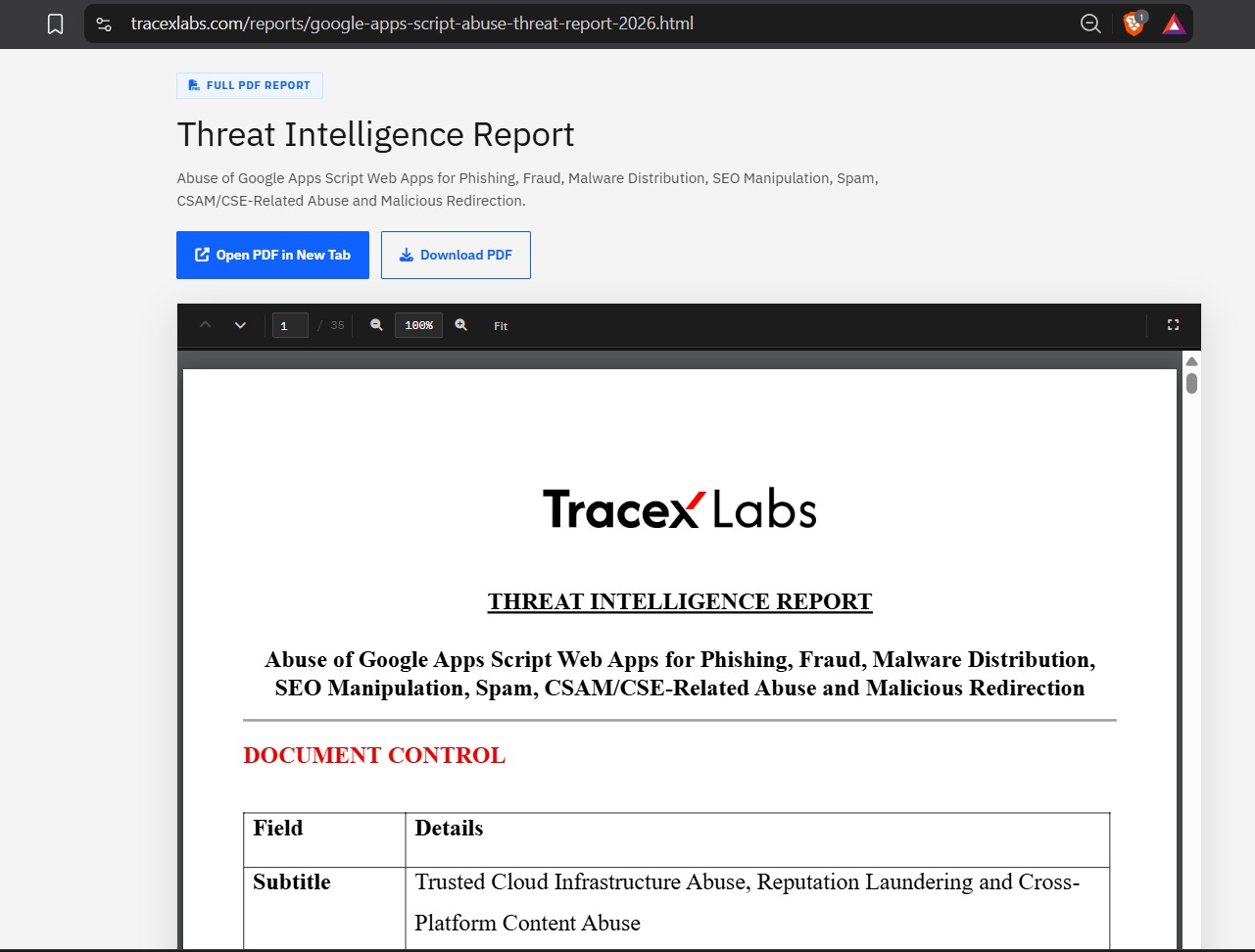
Bhubaneswar (Author – Santosh Kumar): TraceX Labs has released a new threat intelligence report examining the abuse of Google Apps Script Web Apps in phishing, fraud, malware distribution, SEO manipulation, spam, suspected CSAM/CSE-related activity and malicious redirection.
The report, “Abuse of Google Apps Script Web Apps for Phishing, Fraud, Malware Distribution, SEO Manipulation, Spam, CSAM/CSE-Related Abuse and Malicious Redirection,” carries the report ID GLOBAL-026 and was published on September 30, 2026. TraceX Labs has marked the investigation as Active / Monitoring with a High threat assessment.
Google Apps Script Web Apps and abuse
Google Apps Script is a legitimate platform used for development, business automation, education, data processing and Google Workspace workflows. The TraceX Labs report focuses on the potential abuse of this legitimate infrastructure by third parties.
According to the report, Apps Script Web Apps can process HTTP requests, generate HTML, process parameters, interact with external resources and participate in redirect workflows. These capabilities can make a publicly accessible Web App part of a larger campaign.
TraceX Labs describes a potential campaign path in which a user encounters a link through a search engine, social media, email or messaging platform. The user may then reach a Google Apps Script URL before being redirected to another landing page or external infrastructure. That infrastructure may be associated with phishing, fraud, malware, spam or other harmful content.
Phishing, fraud and malware distribution
The investigation covers phishing and credential harvesting, malicious APK distribution, malware delivery, malicious redirects and social engineering.
It also examines investment scams, employment scams, fake payment pages, UPI-related fraud, cryptocurrency-related fraud and impersonation.
TraceX Labs documented Apps Script-associated infrastructure involving APK downloads, malware-related landing pages and redirects toward suspicious payload infrastructure. The report classifies this evidence as Observed / Correlated, while stressing that not every Apps Script deployment should be treated as malicious.
The report also documents investigated investment and employment-related pages. Potential indicators included payment requests, requests for personal information, unrealistic salary claims and external messaging-platform contacts.
SEO manipulation and search spam
SEO manipulation is another major area covered by the TraceX Labs investigation.
The report identifies potential indicators such as keyword-heavy landing pages, doorway pages, automatically generated pages, repeated templates, large numbers of outbound links, redirect chains, affiliate links and campaign-specific URLs.
Where search visibility is deliberately manipulated, TraceX Labs notes that the activity may be relevant to MITRE ATT&CK T1608.006, Stage Capabilities: SEO Poisoning.
The investigation also examines Google video/search spam and movie-piracy-related search infrastructure. TraceX Labs notes that these ecosystems may contain advertising, redirects, malvertising or malware-delivery infrastructure.
Spam, gambling and synthetic media
The report covers several additional abuse categories, including adult/NSFW spam, gambling and betting spam, drug-related spam, deepfake and synthetic-media spam, automated content generation and AI-assisted spam.
TraceX Labs documented investigated infrastructure involving gambling keywords, casino promotions, affiliate links and redirects. The report also examines campaigns combining adult-content and gambling-related material.
Another section examines deepfake and synthetic-media-related infrastructure, including manipulated-media claims, fake celebrity content, synthetic-media services and external distribution platforms.
The report cautions that keywords alone do not establish illegal activity. Drug-related content, for example, requires consideration of the actual content, destination infrastructure, transaction mechanisms and applicable legal context.
Suspected CSAM and CSE-related abuse
The report also examines suspected child sexual exploitation (CSE) and CSAM-related infrastructure.
TraceX Labs classifies the relevant evidence as “Suspected / Corroboration Required” and describes it as an exceptionally sensitive category requiring enhanced evidence handling.
The report recommends that investigators do not unnecessarily download, reproduce or redistribute underlying material in suspected CSAM/CSE or NCII-related investigations. It also recommends using only redacted evidence in public reports.
NCII and sextortion are treated as separate investigative categories in the report, with critical potential impact classifications. TraceX Labs notes that these impact classifications do not mean that every investigated Apps Script deployment is associated with these activities.
A Google URL does not guarantee legitimate content
A key point in the report is that the reputation of the hosting provider should not be used as the only basis for assessing a URL.
TraceX Labs states that a URL hosted under a Google-owned domain does not establish that Google created the content, endorsed it, operates the final destination or that the external infrastructure is trustworthy.
The report also notes that HTTPS does not establish that content is legitimate. HTTPS provides encrypted communication, but it does not by itself establish that the destination is safe.
How security teams can detect Apps Script abuse
TraceX Labs recommends a behaviour-focused approach to detecting potential abuse.
Security teams can monitor suspicious Apps Script URLs, repeated deployment IDs, unusual parameters, known malicious destinations and campaign-specific URL patterns. Web proxy monitoring can examine redirect chains, final destinations, downloaded file types, MIME types and abnormal browser behaviour.
At the endpoint level, the report recommends monitoring suspicious APK downloads, browser-originated downloads, credential submissions and unusual processes.
Threat intelligence teams can further correlate Apps Script URLs with destination domains, IP addresses, ASNs, certificates, URL parameters, file hashes and related infrastructure.
TraceX Labs stresses evidence-based classification
The report recommends classifying investigated activity as Observed, Correlated, Suspected, Potential, Benign or Unknown, depending on the available evidence.
This framework is intended to prevent technical capabilities or isolated indicators from being incorrectly presented as confirmed malicious activity.
TraceX Labs also identifies several limitations, including the extensive legitimate use of Google Apps Script, changing search-engine indexing, rapidly disappearing campaign infrastructure, redirects that may vary according to user-agent or location and possible false positives from reputation services.
TraceX Labs recommends behaviour-based investigation
In its final assessment, TraceX Labs describes abuse of legitimate cloud-hosted application infrastructure as a significant threat-intelligence and defensive-detection challenge.
The report identifies potential Apps Script involvement in campaigns involving SEO poisoning, spam, doorway pages, fraud, phishing, malware distribution, malicious redirection, adult-content spam, NCII, sextortion and suspected CSE/CSAM-related infrastructure. It also covers gambling, drug-related, deepfake, video-search and movie-piracy-related spam.
The recommended investigation model is Discover → Validate → Correlate → Classify → Report. TraceX Labs says investigators should assess behaviour, content, destinations and relationships between campaign infrastructure rather than relying only on the reputation of the hosting provider.
The complete GLOBAL-026 Threat Intelligence Report is available on the TraceX Labs website:
https://tracexlabs.com/reports/google-apps-script-abuse-threat-report-2026.html