

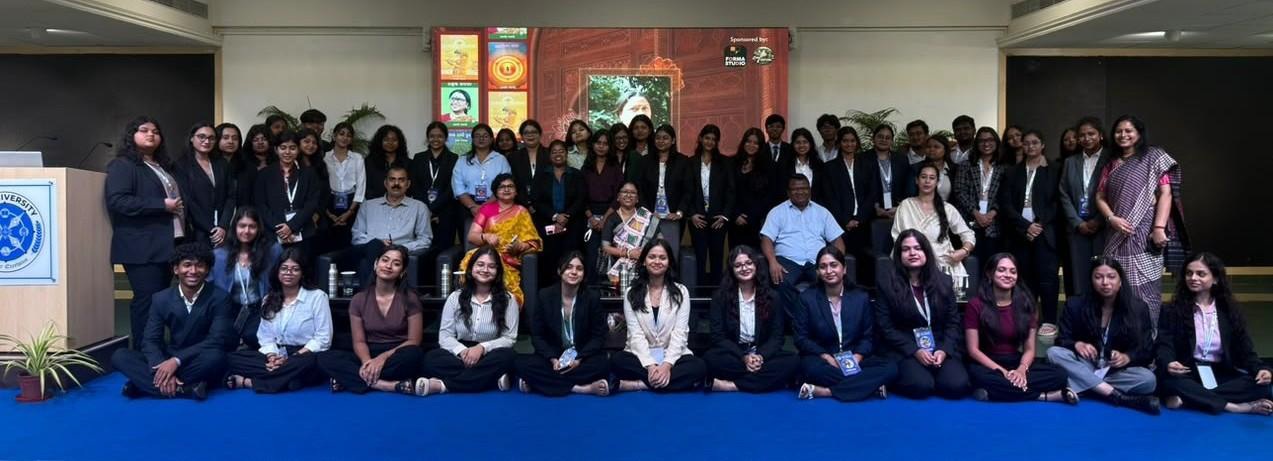
Bhubaneswar : The Department of English, School of Liberal Arts, organized an insightful seminar and guest lecture featuring distinguished Odia poet, scholar, and Sahitya Academy awardee Dr. Aparna Mohanty. The discussion was centred on the themes of feminist ideology, women’s rights, and the nuances of freedom of expression in regional literature.
The session drew an enthusiastic audience of students alongside faculty members. The proceedings commenced with a formal welcome address by Nistha Thakur and Yashodhara, followed by a formal guest introduction by Aditi Panda, who traced Dr. Mohanty’s illustrious literary journey, highlighting Mohanty’s landmark contributions to contemporary Odia feminist poetry, notably, her reinterpretation of mythological figures and subversion of patriarchal idioms.
The introduction set an intellectual foundation for the lecture, followed by Dr. Mohanty’s address. Dr. Mohanty delved into the evolving contours of feminist discourse, particularly through the lens of regional Indian writing. She emphasized that feminist ideology in literature is neither an imported construct nor merely a critique of patriarchy, but an organic assertion of selfhood and dignity. Referring extensively to her celebrated works, Jhia Pain Jharakatiye she illustrated how creative expression can articulate female interiority and resist structural marginalization without divorcing itself from cultural ethos.
The lecture seamlessly transitioned into an engaging interactive dialogue. Students and faculty members actively discussed various dimensions of Dr. Mohanty’s poetic vision, analysing how regional literature uniquely captures intersectional realities of class, tradition, and domesticity.
The discussion also addressed freedom of expression, examining how women writers negotiate societal orthodoxies to carve out spaces for radical candour.
The queries raised by students reflected thorough textual engagement and analytical rigor, bridging literary perspectives with socio-political practice. Dr. Mohanty expressed deep appreciation for the research-oriented pedagogy demonstrated by the department and commended the students’ critical participation. She noted that an environment encouraging interpretive boldness is vital for keeping literary criticism vibrant and socially responsive.
The event concluded with a formal vote of thanks proposed by Prachi Pragnya, who expressed profound gratitude to Dr. Mohanty for sharing her time and scholarly perspectives. She also thanked the university leadership, faculty coordinators, and attendees for making the academic exchange a resounding success.
Overall, the seminar proved to be an enriching intellectual experience, leaving the audience with fresh perspectives on gender, literature, and the transformative power of the written word.
Dr. Sachidananda Panda
XIM University