

Superintelligence will be steered by numbers, yet few can see where those numbers come from. This article shows how humans write the ranges AI must stay within, and how mathematics checks every governed AI action against them before it runs. Two filed Metainventions place any measurement, in any field, between 0 and 1, whether for one action or billions. This article covers one portion of each invention: the ranges and the checks against them.
LIVE www.0to1doctrine.com
NEW HERE? START WITH 0 AND 1
Any measure, from a drug dose to a delivery time to a file’s years in storage, can be written as a value between 0 and 1. A band is a range on that scale, and the limits bands are checked against are written by humans.
The 0→1 Doctrine checks each governed AI action against those limits before it runs, through a multi-token chain whose constraints flow forward and back while the action runs, and can record who defined each rule.
BBAT, the newer filing, sorts stored records, dark data included, against limits before they are retained, purged or promoted, and seals each decision in a receipt that can record that a measurement came from an attested source. Read on to see how each limit can carry its author’s name.
TWO SETS OF NUMBERS
Ask an AI a question and it turns your words into numbers it learned for itself during training. No human wrote those. The 0→1 Doctrine uses another set: ranges humans declare for what an action may do, checked before it runs. One set is learned. The other is written.
WHO DECIDED THIS NUMBER?
Show anyone a safety limit and the first question is simple: who decided it? Regulators, standards bodies and suppliers each publish limits they call safe.
WHAT 0 AND 1 STAND FOR
Zero is the bottom of a ruler and one is the top. A reading in any unit, such as micrograms or days, takes its place between them. Needs, abilities and limits sit on one ruler and can be compared directly.
THE FIRST STEP, WORKED THROUGH
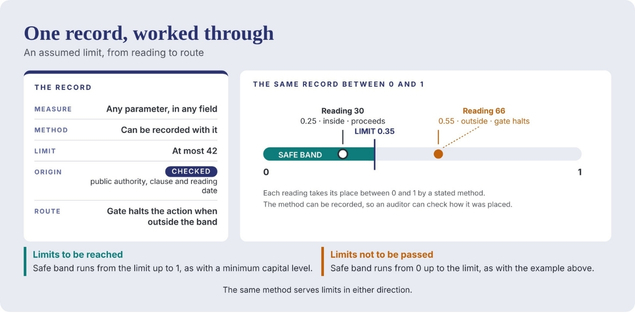
Each need and each ability becomes a band, and they are compared for fit, for example by checking whether the bands overlap. On a scale of 0 to 120, an assumed checked limit of 42 becomes 0.35, so the safe band runs from 0 to 0.35. A reading of 30 becomes 0.25, inside it, and may proceed. A reading of 66 becomes 0.55, outside it, and the gate halts the action. The scale can follow a standard published by a science body or regulator. Straight-line scaling is used here; the filings provide other models. This check sits inside a multi-token chain, which governs the action before and while it runs.
TRACING BACK, AND WHICH WAY IT POINTS
The method and the scale can be recorded with each record, so an auditor can check how a value was placed on the ruler. In the Doctrine, the raw reading can stay on the user’s device, and only its band travels. A limit that must be reached, such as a minimum capital level, marks the safe band from the limit up to 1. A limit that must not be passed marks it from 0 up to the limit. Some ranges have two limits, a lower and an upper end, such as a safe body temperature.
WHERE EACH INVENTION USES THE SCALE
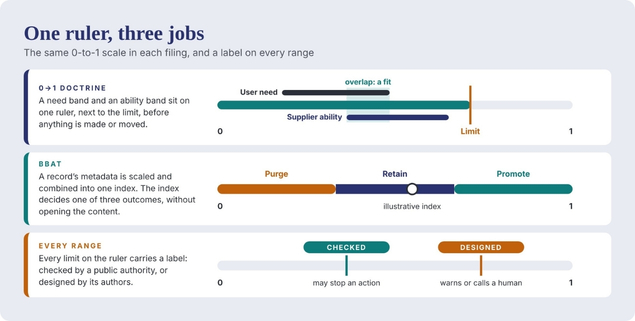
In the Doctrine, a user’s need and a supplier’s ability are both written on the scale, then compared with limits for safety, law and place before anything is made or moved. In BBAT, a record’s metadata is scaled the same way and combined into one score, which decides one of three outcomes: retain, purge or promote, without opening the record. Incomplete or contradictory metadata, or an active legal hold, sends the record to a human reviewer who cannot see the stored content, and a held record cannot be promoted until the hold is lifted.
TWO LABELS ON EVERY RANGE
Humans write every range, and a label built to work with the filings says which kind. A checked record takes its limit from a named public authority, with the clause and a reading date. A designed record carries a threshold set by its authors, used where no authority has set one. Where a source states a rule rather than a number, such as a ban, the authority that applies the range sets the pass mark on the scale. The label travels with the number.
WHO WROTE THE RULE
In the Doctrine, governance rules can be defined by deployment administrators, regulators or other governance bodies, and the system can record who defined each rule and which version applied. Each completed action can end in a sealed receipt of what was checked. In BBAT’s release path the receipt is sealed first, and release stays blocked without it.
DECIDE, ADVISE OR ASK A HUMAN
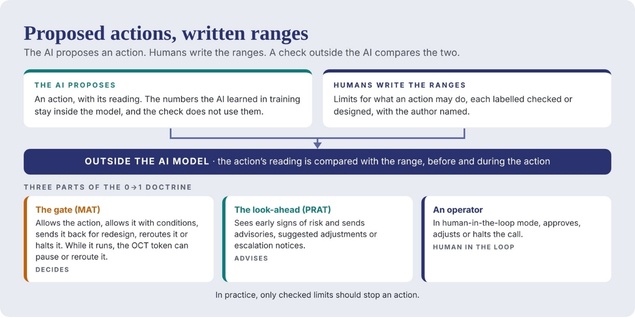
Three parts of the Doctrine act on each governed action. The Manufacturing Authorization Token (MAT) gate allows the action, allows it with conditions, sends it back for redesign, reroutes it, or halts it before it runs. While an approved action runs, the Orchestration and Compliance Token (OCT) monitors live limits and can pause or reroute it. The Predictive Risk Advisory Token (PRAT) looks ahead and sends advisories, suggested adjustments or escalation notices. In human-in-the-loop mode, an authorised operator can approve, adjust or halt the call.
STRONG EVIDENCE, STRONG ACTION
The filed Doctrine grades its outcomes, as Figure 3 shows. A sound practice is to let the force of a response follow the evidence behind the range: a checked limit may stop an action, while a designed threshold should warn or call a human, not halt alone.
BOUND BY MATHEMATICS
The AI does not have to understand a range. It proposes an action, and the system converts the reading and compares it with the range. If a model misreads, forgets or is manipulated, the same comparison still runs. Its governed actions must pass a mathematical check outside the model, whatever the model says.
CLOSING NOTE
Whatever superintelligence becomes, let it answer to ranges written by humans, each carrying its author’s name.
LIVE www.0to1doctrine.com
This can be tested, live, via API, governed against ungoverned, side by side.
THE INVENTOR
Inventor, systems theorist and serial entrepreneur Vatsal Soin, an SIM–RMIT and NTU alumnus, holds grants in the US, Japan, India and beyond, with filings on six continents; his newest grant, for AI footwear, came in August 2026. His inventions span footwear, apparel fit, Sharable Size Cards, digital twins, robotics, global governed data, archive triage, quantum-resilient cryptography and AI governance. All roads lead to 0→1.
SELECTED REFERENCES
Granted: US Patent 12,446,652 B2 · Japan Patent 7560909 · India Patents 454081 and 599317. Filed: PCT/IN2025/051943 · US 19/489,595 · India 202511115781 · Australia AU2022450649 · India 202611113867 (23 September 2026) · PCT/IN2026/052042 (1 October 2026).
DISCLAIMER
Informational only. Not certified. No endorsement implied. Not investment advice. Examples are illustrative, not field results. Vatsal Soin · © 2026 All Rights Reserved.