

AI, and in time artificial general intelligence (AGI), will want to learn from stored records, and someone must supply them. This article shows owners, boards, investors and heads of state what their archives can supply and earn without handing over records. Band-Based Archive Triage (BBAT), which uses the 0 to 1 scale of the 0→1 Doctrine, sorts records by labels and releases only ranges checked inside a sealed chip, never raw data.
THE IDEA IN BRIEF
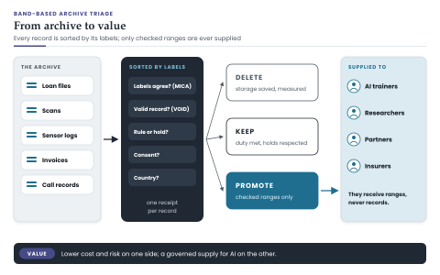
The 0→1 Doctrine, a filed invention, places needs and abilities as ranges on one line from 0 to 1 and lets AI act only where they overlap and every required check passes. BBAT, filed separately, brings the same scale to stored records, new or old. It sorts them by their labels, marking each one keep, delete or promote for checked supply.
EVERY ARCHIVE, A SUPPLIER IN WAITING
AI is nearing a data wall: much public text has already been used. Synthetic data made by AI can fill gaps, but models trained mostly on their own output risk model collapse, drifting away from the real world. Meanwhile, real history sits in zettabytes of loan files, scans, logs and records, kept in data centres that draw gigawatts. The question for an owner is how to supply that learning without supplying the records themselves.
SORT BEFORE YOU SUPPLY
BBAT reads each record’s labels, such as age, category, last use, consent, legal hold, country and storage cost, and marks it keep, delete or promote, meaning eligible for checked supply. MICA (Metadata Inconsistency Check Module) flags labels that contradict each other, VOID (Verified Omission of Invalid Data) sets broken records aside, and large batches still leave one receipt per record.
What a holder gains: storage savings measured before and after, not assumed.
EARN WITHOUT EXPOSURE
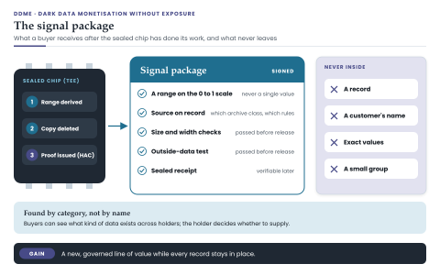
Promoted records can be offered through Dark Data Monetisation Without Exposure (DDME). The work runs inside a Trusted Execution Environment (TEE), a locked area of a chip; only there is content used, to derive a range. A range leaves only after a Hardware Attestation Certificate (HAC) attests that the working copy was deleted under Delete-Before-Share. Groups too small are refused, narrow ranges are widened, and each range is tested against outside data.
What a holder gains: a new, governed line of value while every record stays in place.
BE FOUND WITHOUT BEING NAMED
Buyers first need to know what exists. SCAN (Systemic Category-level Availability Notice) shows, by category, what kind of data is available across holders, without naming any holder or record.
What a holder gains: demand can reach an archive without its name, or its customers’ names, being made public.
TRAIN TOGETHER, STAY APART
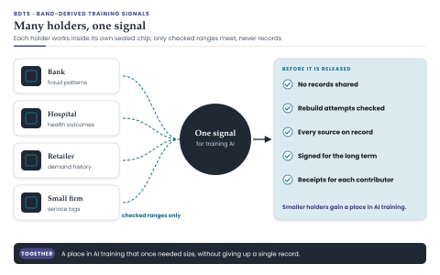
Band-Derived Training Signals (BDTS) let several holders, including smaller ones, contribute to one signal for training AI, such as a fraud pattern across many banks or ten years of de-identified health outcomes. No records are shared, each signal is checked against attempts to rebuild any single record, and its sources are on record. Each contributor’s records stay inside its own sealed chip.
What a holder gains: a way into AI training without needing size.
SUPPLYING AI AGENTS SAFELY
Many future buyers will be AI agents. The Cross-Agent Aggregation Detector (CAAD) reads only sealed receipts and sends a case to human review when many agents draw too much from the same data. Signal packages can be signed with methods built to resist future quantum computers.
What a holder gains: a watch against quiet over-collection by AI customers.
PROOF THAT PAYS
Every keep, delete or promote is designed to leave a sealed BBAT receipt recording the outcome and rule, never the content. One receipt can serve auditors, insurers and partners, which can cut repeated checks. With the holder’s permission, an investor or acquirer can check how an archive has been governed before valuing it.
What a holder gains: governed data that can be easier to insure, fund and trust.
WHAT NATIONS CAN SUPPLY
Governments hold some of the richest archives: health, tax, transport, land and climate records. Through BBAT, a ministry can supply research signals to universities, health bodies or partner nations while records stay inside the country, each country’s configured rules apply, and legal holds always reach a reviewer through the Human Override Pathway (HOP).
What a holder gains: national data that serves science and growth without leaving home.
A SUPPLY IN PRACTICE
A telecom firm holds ten years of network logs. BBAT marks logs no rule needs for deletion, sends logs tied to billing disputes to a reviewer, and promotes cell-site performance logs. Inside the chip, those become ranges for a partner training AI to plan networks. The partner never sees a call record, and the firm keeps a receipt for each step.
WHERE THE 0→1 DOCTRINE FITS
BBAT uses the 0 to 1 scale of the 0→1 Doctrine, an earlier filed invention. When a buyer’s AI later acts on a signal, the Doctrine can check that act first, where the act is routed through it: it proceeds only where ranges overlap and every must-pass check clears.
WHEN SUPERINTELLIGENCE ARRIVES
AI agents already search and combine data at a speed few teams can follow, and AGI and superintelligence may follow. A smarter AI will seek richer data, more often. Where BBAT is in use, it receives ranges built under rules people set, never the records; every supply leaves a receipt, and the pattern of its requests is watched.
HONEST LIMITS
A company can use BBAT entirely in-house, to sort its own archives and train its own AI, or also supply others where the law allows. Labels must be accurate, so doubtful ones go to a reviewer. A range carries less detail than a record, so each buyer judges its value for its own use, and prices are set by contract.
QUESTIONS OWNERS ASK
| 01 Does it work with our current storage? It is designed to run where data sits: cloud, data centre or on site. | 02 Can we start with one archive? Yes. Sorting alone can cut storage before any supply. |
| 03 What if consent changes after supply begins? Future steps pause; earlier receipts stay intact. | 04 Who can verify our receipts? Authorised auditors, without entering the archive. |
| 05 Does a buyer ever see a customer? A buyer receives ranges only, never a customer’s record. | 06 Can earlier deletions be checked later? Yes, through their sealed receipts, years on. |
CLOSING NOTE
The next great buyer of data may not be human. Holders who supply ranges, not records, can serve AGI and superintelligence while every record stays where the law placed it.
This can be tested, live, via API, governed against ungoverned, side by side.
THE INVENTOR
Systems theorist, inventor, and serial entrepreneur Vatsal Soin holds grants in the US, Japan, India and more; filings span six continents; latest grant, AI footwear, August 2026. Inventions: footwear, apparel fit, Sharable Size Cards, digital twins, robotics, global governed data, archive triage, quantum-resilient cryptography, AI governance. SIM–RMIT and NTU alumnus. Every prior invention was a step; 0→1 is the destination.
SELECTED REFERENCES
Granted: US Patent 12,446,652 B2 · Japan Patent 7560909 · India Patents 454081 and 599317. Filed: PCT/IN2025/051943 · US 19/489,595 · India 202511115781 · Australia AU2022450649 · India 202611113867 (23 September 2026) · PCT/IN2026/052042 (1 October 2026).
DISCLAIMER
Informational only. Not certified. No endorsement implied. Not investment advice. Examples are illustrative, not field results. Vatsal Soin · © 2026 All Rights Reserved.