

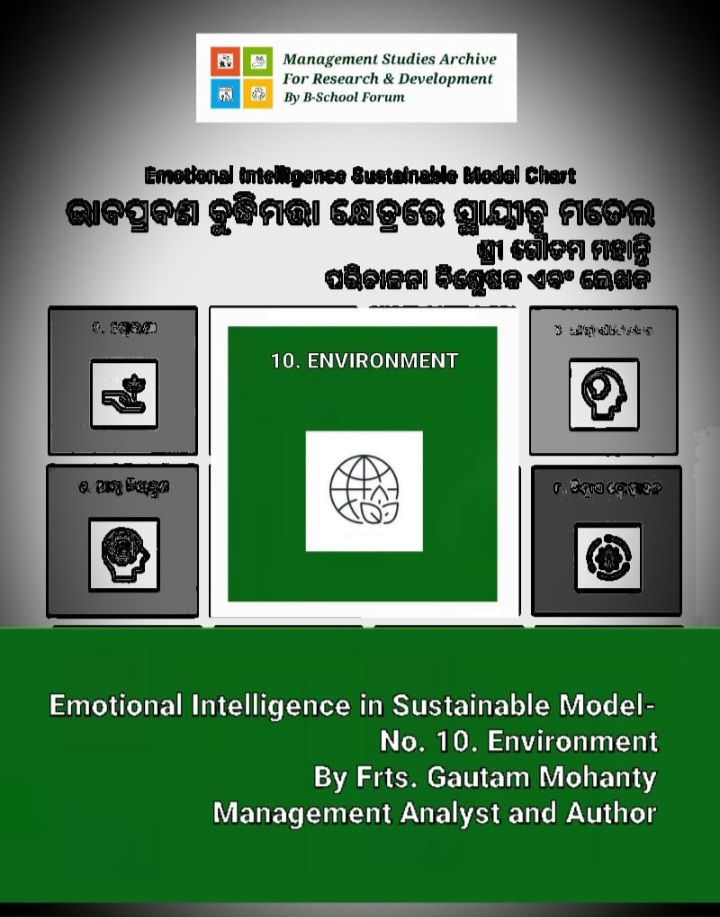
Bhubaneswar : An environment is the sum total of all living (biotic) and non-living (abiotic) elements, conditions, and influences that surround and affect the survival, development, and functioning of an organism or community. It encompasses natural systems (like the air, water, and land) as well as human-made and social settings.
Understanding the environment involves looking at several core subtopics:
- Components of the Environment
Environments are typically divided into two categories:
Biotic Elements: The living components, including all plants, animals, fungi, and microorganisms.
*Abiotic Elements: The non-living, physical, and chemical factors such as climate, sunlight, soil, rocks, and the atmosphere. - Major Natural Spheres
The Earth’s natural environment is often studied across four interconnected spheres:
Atmosphere: The layer of gases surrounding the Earth that provides air and regulates temperature.
Hydrosphere: All the water on the planet, including oceans, rivers, lakes, and groundwater.
Lithosphere: The solid, outer crust of the Earth, including soil and minerals.
Biosphere: The global ecological system that integrates all living beings and their relationships. - Types of Environments
Natural Environment: Ecosystems and landscapes—such as forests, deserts, and oceans—that function organically without massive human intervention.
Human-Made (Anthropogenic) Environment: Areas altered or created by humans, including urban environments (cities and towns), agricultural lands, and industrial zones.
Work or Social Environment: The surrounding circumstances, culture, and conditions that influence an individual’s daily life, feelings, or professional functioning.
Why the Environment Matters
The environment forms the critical foundation for life on Earth, providing essential resources like clean water, food, and building materials. Because natural systems are interconnected, maintaining ecological health is vital to sustaining human livelihoods, protecting global biodiversity, and mitigating climate change.
The research indicates that specific family structures and dynamics, such as attachment styles and parenting approaches, significantly influence EI development. Young adults’ emotional intelligence is significantly impacted by their family environment.
Environmental enrichment: Environmental enrichment affects cognition and intellectual development from a neurobiological perspective. More stimulating environments can increase the number of synapses in the brain which increases synaptic activity. In humans, this is most likely to occur during the development of the brain but can also occur in adults. Most of the research on environmental enrichment has been carried out on non human animals. In an experiment, four different habitats were set up to test how environmental enrichment or relative impoverishment affected rats‟ performance on various measures of intelligent behavior. First, rats were isolated, each to its own cage. In a second condition, the rats were still in isolation, but this time they had some toy, or enriching object in the cage with them. The third condition placed the rats in cages with each other, so they were receiving social enrichment, without any enriching object. The fourth and final condition exposed the rats to both social interaction and some form of object enrichment. In measuring intellectual capacity, the rats who had both forms of enrichment performed best, the ones with social enrichment performed second best, and the ones with a toy in their cage performed still better than the rats with no toy or other rats. When the volume of the rat’s cortices was measured the amount of enrichment again correlated with larger volume, which is an indicator of more synaptic connections, and greater intelligence. Attaining this sort of information in humans would be difficult as it requires histological research. However, studies where environmental deprivation has occurred provide insight and indicate that a lack of stimulation can lead to cognitive impairment.
Intelligence is a singular faculty that is brought to bear in any problem-solving situation. A century ago, intelligence was considered a quality that could be measured by an intelligence quotient (IQ) test. The study of intelligence is important because findings can give a better understanding of human creativity, psychological development, and emotion. The existence of intelligence has been attributed to both nature and nurture, but the truth behind it may be something of a mix of both. There has been great interest in the field of intelligence research to determine environmental influences on the human development. Environment is an open system, every element of it, whether living or non-living is interrelated. With the passing of time, the human being gradually occupies the central place in it. This is because the activities of the human beings are increasingly influencing the direction of development of environment. Environment and Emotional intelligence are correlated with each other and environment is having great impact on different levels of intelligence. The objective is to review the evidence for an association between environment and emotional intelligence.
Courtesy: NATIONAL EDUCATION BOARD FOR MANAGEMENT TRAINING,
Vocational Skill Tennary
by B-School Forum Knowledge Centre.
Frts. Gautam Mohanty Management Analyst and Author, Bhubaneswar.