

New Delhi (By Bratatee Pradhan):
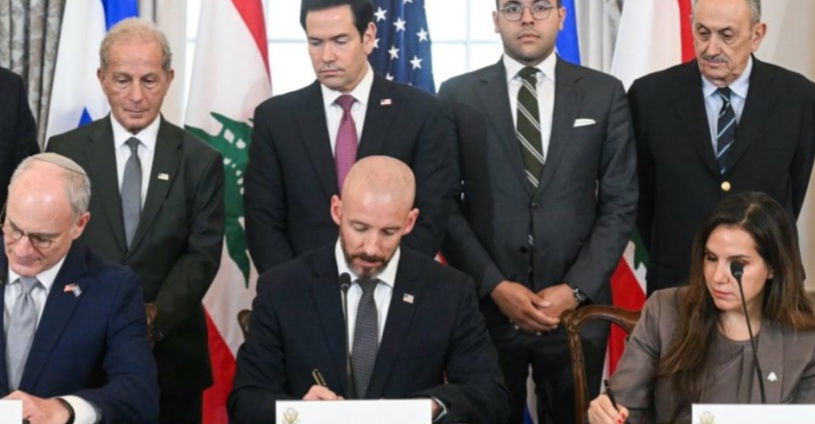
In a significant diplomatic development for the Middle East, Israel and
Lebanon have signed a United States-brokered framework agreement
aimed at reducing decades of hostility and paving the way for future peace
negotiations. Described by US officials as the “first step toward peace,” the
agreement seeks to strengthen security along the volatile Israel-Lebanon
border while addressing long-standing disputes that have fueled repeated
military confrontations.
The framework, signed in Washington, is not a formal peace treaty but a
roadmap outlining a phased process toward normalization and lasting
stability. It focuses on enhancing Lebanon’s sovereignty, preventing cross-
border attacks, and creating conditions for the eventual withdrawal of
Israeli forces from parts of southern Lebanon. A key element of the
agreement is the gradual disarmament of all non-state armed groups in
Lebanon, particularly Hezbollah, alongside increased support for the
Lebanese Armed Forces to assume full responsibility for the country’s
security.
To oversee the implementation of the agreement, the United States will
establish a trilateral military coordination mechanism involving American,
Israeli, and Lebanese officials. Washington has also pledged additional
military assistance to Lebanon’s armed forces and humanitarian aid to
support communities affected by months of conflict. Officials believe that
strengthening Lebanon’s state institutions will help reduce the influence of
armed militias and improve regional stability.
Israeli Prime Minister Benjamin Netanyahu welcomed the agreement,
calling it a strategic achievement that could significantly weaken the
influence of Iran and Hezbollah in Lebanon. He stated that Israel remains
committed to the framework but stressed that Israeli troops would
continue to maintain a security presence in designated areas of southern
Lebanon until Hezbollah is fully disarmed and no longer poses a threat to
northern Israeli communities. According to Israeli officials, the agreement
represents an opportunity to create a more secure northern border while
opening the door to future diplomatic engagement.
Lebanese President Joseph Aoun also praised the agreement, describing it
as an important opportunity to restore Lebanon’s sovereignty and
strengthen the authority of the state. He expressed hope that the
framework would facilitate the return of displaced residents, accelerate
reconstruction efforts in southern Lebanon, and allow the Lebanese Armed
Forces to gradually establish exclusive control over the country’s security.
The Lebanese government has maintained that only the state should
possess weapons and exercise military authority.
However, the agreement has faced immediate and fierce opposition from
Hezbollah, the Iran-backed political and militant group that was not
involved in the negotiations. Hezbollah rejected the framework outright,
insisting that its armed wing remains essential for defending Lebanon
against Israeli military operations. The group argues that surrendering its
weapons before Israel completely withdraws from disputed areas would
leave Lebanon vulnerable and undermine its national security.
Hezbollah lawmaker Hassan Fadlallah issued a strong warning following
the announcement of the agreement, stating that any attempt by the Lebanese government or military to forcibly disarm the organization could
trigger a civil war. He accused the United States of supporting efforts to
dismantle what Hezbollah describes as Lebanon’s “resistance” and vowed
that the group would oppose any move to confiscate its weapons. The
remarks underscore the deep political divisions within Lebanon, where
Hezbollah continues to hold considerable military capabilities and
significant political influence despite increasing domestic criticism.
Regional analysts view the framework agreement as one of the most
important diplomatic initiatives between Israel and Lebanon in decades. If
successfully implemented, it could reduce the risk of another major
conflict along the border, encourage economic recovery in southern
Lebanon, and reshape the regional security landscape. Nevertheless,
experts caution that the agreement faces substantial obstacles,
particularly over the contentious issue of Hezbollah’s future role and the
sequencing of Israeli troop withdrawals and militia disarmament.
The international community has broadly welcomed the agreement as a
rare opportunity to reduce tensions in one of the Middle East’s most
volatile regions. However, the success of the initiative will depend on
sustained political commitment, effective implementation of its provisions,
and the willingness of all stakeholders to avoid renewed confrontation.
With Hezbollah firmly rejecting the deal and warning of internal conflict,
the framework marks both a promising diplomatic opening and the
beginning of what is expected to be a challenging and uncertain path
toward lasting peace.