
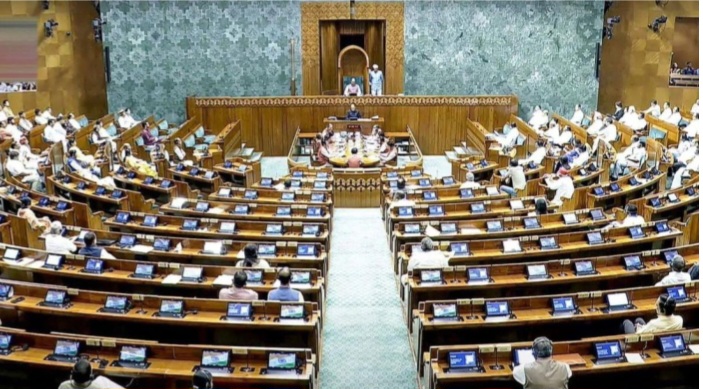
To hike Lok Sabha strength, Government works on more clarity; eyes South, DMK support
New Delhi(09/06/2026) By Ishani Chhatoraj : The Central government is reportedly intensifying efforts to build political consensus on a proposed increase in the strength of the Lok Sabha, a move that is expected to have significant implications for parliamentary representation and the future of electoral boundaries in India.As part of the process, the government is seeking greater clarity on key issues related to delimitation and representation while reaching out to political parties in southern states, including the Dravida Munnetra Kazhagam (DMK).The issue has emerged as one of the most consequential political and constitutional discussions in recent years, with leaders across party lines closely monitoring developments.While the government has not formally announced any final proposal, sources indicate that extensive consultations are underway to address concerns that have been raised by several states regarding the potential impact of an increase in parliamentary seats.The debate is closely linked to the delimitation process, which involves redrawing the boundaries of parliamentary and assembly constituencies based on population changes.Many southern states have expressed apprehension that a future delimitation exercise based solely on population growth could alter the balance of representation in Parliament, potentially reducing their relative influence despite significant progress in population control and social development indicators.Recognising these concerns, government officials are understood to be exploring mechanisms that could ensure broader acceptance of any proposed changes.Political observers suggest that obtaining the support of major regional parties will be critical if the Centre seeks to move forward with reforms involving parliamentary representation.Among the parties being closely watched is the DMK, the ruling party in Tamil Nadu and one of the most influential regional players in national politics.The party has consistently voiced concerns about delimitation and representation, arguing that states which successfully implemented population-control measures should not be disadvantaged in the allocation of parliamentary seats.DMK leaders have maintained that any revision of representation must take into account principles of fairness and federal balance.They have repeatedly called for extensive consultations before any decisions are made on matters affecting the political representation of states.Political analysts note that securing the support—or at least reducing the opposition—of southern regional parties could prove crucial for the Centre.States such as Tamil Nadu, Kerala, Karnataka, Telangana, and Andhra Pradesh have frequently raised concerns that population-based redistribution of seats could shift political weight toward more populous northern states.Supporters of increasing the Lok Sabha's strength argue that the move is necessary to improve representation in a country whose population has grown substantially since the current seat allocation framework was established.They contend that a larger Parliament would allow elected representatives to serve smaller constituencies and strengthen democratic participation.Advocates also point to the construction of the new Parliament building as evidence of preparations for accommodating a larger number of lawmakers in the future.Several constitutional experts have suggested that an expansion of seats may become unavoidable as India's population and electorate continue to grow.However, critics caution that any increase in parliamentary strength must be accompanied by safeguards to preserve the federal balance between states.They argue that the issue is not merely about the number of seats but also about ensuring equitable representation and maintaining trust among states with differing demographic trends.The Centre is therefore believed to be working on proposals that could provide greater clarity regarding how representation would be determined and whether any compensatory mechanisms could address the concerns of states that have experienced slower population growth.The discussion has gained renewed attention as political parties prepare for future electoral cycles and broader constitutional debates.While no final decisions have been announced, the issue is expected to remain a major subject of political consultation in the coming months.Experts believe that any significant reform to parliamentary representation will require careful balancing of democratic principles, demographic realities, and federal considerations.Building consensus among states and political parties is likely to be essential for ensuring the legitimacy and long-term acceptance of any changes.As discussions continue, the government's outreach to southern political stakeholders and regional parties such as the DMK is expected to play a pivotal role in shaping the future course of the proposal.The outcome could have far- reaching consequences for India's electoral landscape and the structure of parliamentary representation for decades to come.
Trending

7.5-magnitude quake strikes Venezuela seconds after Foreshock

Government reiterates Ethanol Blending Programme is scientifically validated and continuously monitored

Cabinet reshuffle buzz grows after George Kurian's exit; major changes in Modi Government expected soon

Ministry of Mines auctions 10 critical mineral blocks under 7th tranche

Odisha strengthens Kharif 2026 preparedness following review by Union Agriculture Minister
Visit Our Odia News Site