

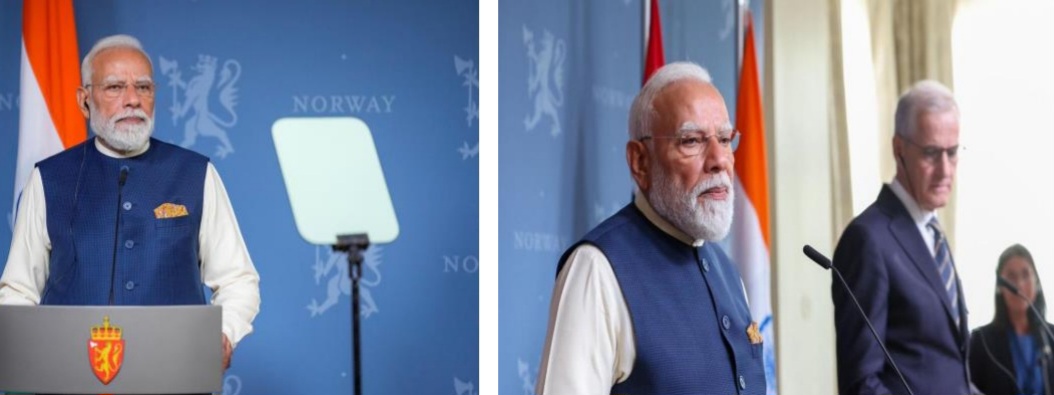
New Delhi(20/05/2026) By Subham Bose: Prime Minister Narendra Modi once again avoided taking questions from the media during a joint appearance with Norwegian Prime Minister Jonas Gahr Store, prompting discussion over India’s approach to press interactions and transparency in high-level diplomatic engagements. The issue came into focus during Prime Minister Modi’s official visit to Norway, where both leaders addressed the media after bilateral talks aimed at strengthening cooperation in areas such as green energy, maritime trade, climate action, and digital innovation.
While the two leaders delivered prepared statements outlining the outcomes of their discussions, no questions were taken from journalists. The absence of a question-and-answer session drew attention after Prime Minister Store, when asked about the format of the media interaction, remarked that countries follow “different traditions” when it comes to dealing with the press.
His comment was widely interpreted as a diplomatic acknowledgment of the contrasting media cultures in India and Norway. Store emphasized that his government remains committed to media openness and democratic engagement, but refrained from directly criticizing the Indian Prime Minister.
“There are different traditions in different countries regarding press conferences and interactions,” he said, maintaining a cautious and respectful tone. Prime Minister Modi has rarely addressed open press conferences during his tenure, especially in bilateral diplomatic settings.
Since taking office in 2014, he has generally communicated through speeches, interviews with selected platforms, social media outreach, and radio broadcasts such as Mann Ki Baat.
Open-ended press interactions, particularly those involving unscripted questions from journalists, have been notably infrequent. The latest episode has reignited debate among political commentators, opposition parties, and media observers over the state of press freedom and government accountability in India.
Critics argue that regular press conferences are a vital democratic institution that allow journalists to question leaders on public policy, governance failures, economic concerns, and foreign affairs. Opposition leaders were quick to seize upon the remarks from the Norwegian Prime Minister.
Several opposition figures claimed the episode highlighted the increasing distance between the Indian government and independent media scrutiny.
They accused the ruling administration of favoring tightly controlled communication formats over transparent engagement. Supporters of the government, however, defended Modi’s communication style, arguing that the Prime Minister remains directly connected with citizens through digital platforms and large public interactions.
They contend that his speeches, public addresses, and interviews adequately convey government policy and national priorities. The bilateral meeting itself focused heavily on expanding India-Norway cooperation in renewable energy and sustainable development.
Norway, known globally for its expertise in clean energy and electric mobility, expressed interest in deepening collaboration with India in offshore wind projects, green shipping, and Arctic research. India and Norway also discussed enhancing investments, maritime cooperation, and technology partnerships.
Officials from both countries described the talks as “productive” and aimed at strengthening strategic ties amid evolving global economic and geopolitical challenges. The diplomatic visit comes at a time when India is seeking to deepen engagement with European nations on trade, climate commitments, and technological cooperation.
Norway, though not a member of the European Union, plays an influential role in energy and environmental policy discussions across Europe. Despite the positive diplomatic outcomes, public attention remained focused on the unusual spotlight cast on media access and democratic practices.
Analysts noted that such discussions have become increasingly common during international visits involving Prime Minister Modi, especially in Western democracies where press briefings and direct questioning of political leaders are standard practice. Media advocacy groups have repeatedly expressed concern over shrinking opportunities for direct questioning of senior Indian government officials.
Some international press freedom organizations have also pointed to what they describe as increasing pressure on independent journalism in India.
The Indian government, however, has consistently rejected allegations of curbing press freedom, asserting that India maintains a vibrant and diverse media landscape. Political observers say the Norwegian Prime Minister’s carefully worded statement reflected the diplomatic balancing act often required in international relations.
Rather than openly criticizing a visiting leader, Store chose language that acknowledged differences without escalating tensions. As India continues to project itself as a leading democratic voice on the global stage, discussions around institutional transparency, media access, and political communication are likely to remain part of the broader conversation surrounding its international engagements. The visit ultimately underscored not only the growing partnership between India and Norway, but also the contrasting democratic traditions that shape how leaders engage with the press in different parts of the world.