

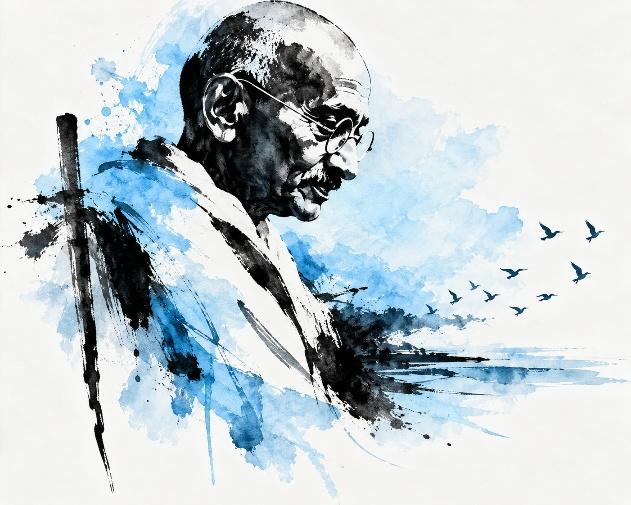

On 2 October 1946, as India moved towards independence, but communal violence threatened to tear the country apart, Gandhi walked through the villages of Noakhali rather than retreat into the security of political power. Nearly eight decades later, the image remains unsettlingly relevant. The world has changed, the instruments of war have become technologically sophisticated, and political violence now operates through missiles, drones, propaganda, terrorism and economic coercion. Yet Gandhi’s central question remains difficult to dismiss: what happens to humanity when force becomes the principal language of politics?
Gandhi, however, cannot be reduced to the familiar icon of the spinning wheel, the loincloth and nonviolence. His political thought was neither a simple doctrine of pacifism nor a universally applicable formula. It was an evolving experiment in truth, ethics and political action. His insistence that “nonviolence of the strong is infinitely braver than their violence” makes nonviolence a question of moral courage rather than passive submission. The distinction is crucial. Gandhi did not imagine nonviolence as doing nothing. Satyagraha was intended to confront power, expose injustice and compel political negotiation without reproducing the violence of the oppressor. The historical Gandhi and the later Gandhian icon are not identical. The former was contradictory, experimental and frequently controversial. The latter is a constructed cultural figure, invoked by governments, activists, institutions and political movements for purposes that may have little relationship with his original arguments. Judith M. Brown and Anthony Parel observe that Gandhi has been repeatedly appropriated, producing “further ‘Gandhis’” as different groups adapt his image to their own agendas.
This distinction matters because Gandhi’s legacy is often reduced to a ceremonial vocabulary: truth, peace, simplicity, nonviolence. Such vocabulary can easily become decorative. “Gandhianism”, if treated merely as a decorative slogan or some collection of quotations, loses its political difficulty. Satyagraha demanded discipline, sacrifice, constructive work and the willingness to suffer rather than inflict suffering. Joan V. Bondurant consequently warned that invoking Gandhi does not necessarily mean understanding him. “Nonviolence alone is weak,” she argued, because non-cooperation and civil disobedience require a constructive political programme to become effective. The fallacy, therefore, lies not in Gandhi’s principles alone but in their simplification. Gandhi’s thought contains tensions that cannot be concealed by reverence. His position on caste, for instance, evolved considerably and remained deeply contested. Nishikant Kolge’s study demonstrates that Gandhi’s writings moved between criticism of caste inequality and claims about the beneficial aspects of caste, creating contradictions that distinguish his approach from B. R. Ambedkar’s more radical demand for annihilation of caste. The disagreement is not peripheral. It exposes a fundamental question within Gandhian reformism: can a deeply hierarchical social order be transformed primarily through moral persuasion, or does structural injustice require structural rupture?
There are similar tensions in Gandhi’s relationship with violence. His public image as an absolute pacifist obscures the historical record. David Hardiman notes that Gandhi supported Indian participation in the British military effort during the Boer War and the First World War and, at certain points, regarded armed defence as preferable to cowardice.
However, this does not invalidate his later commitment to nonviolence, but it complicates the mythology of a perfectly consistent pacifist. Gandhianism therefore should not be treated as a finished system. It is better understood as an ethical experiment marked by development, contradiction and revision. The contemporary world presents Gandhi with his hardest test. Wars are no longer fought only across clearly defined battlefields. Civilians become targets, digital platforms become instruments of psychological warfare, and violence is increasingly mediated by technologies that distance decision-makers from its consequences. In such a world, Gandhi’s insistence on the moral consequences of means becomes disturbingly relevant.
His proposition was uncompromising: “violence cannot be (destroyed) by counterviolence”. The statement does not provide a practical answer to every situation involving armed aggression. A state confronted by invasion, terrorism or mass atrocities faces responsibilities that cannot simply be dissolved into individual ethics. Gandhi himself wrestled with precisely such dilemmas. The difficulty of his position is therefore also its intellectual value. His relevance lies less in offering a ready-made strategy for every contemporary war than in challenging the assumption that military victory automatically constitutes moral or political success. Gandhi asks a more uncomfortable question: what kind of society is produced by the means employed to secure peace?
This question extends beyond war. Political polarization, hate speech, majoritarian anxieties, economic inequality and the normalization of humiliation create forms of social violence that precede physical conflict. Gandhi’s constructive programme, with its emphasis on self-reliance, local participation and social responsibility, therefore, deserves attention alongside his more famous campaigns of resistance. Gandhi’s continuing relevance should not require his canonization. Judith Brown describes him as both historically significant and a figure capable of speaking to contemporary concerns, particularly religious violence and the relationship between belief and inequality. Yet relevance is not immunity from criticism. Gandhi matters not as a marble icon but as a demanding interlocutor who compels modern politics to confront the tensions between ends and means, resistance and retaliation, conscience and collective action. His failures, no less than his achievements, carry lessons beyond moral slogans.
The theatre of wars thus places Gandhi before a contemporary audience once again. The question is not whether Gandhi can stop a missile, negotiate a ceasefire or replace the institutions of modern defence. He cannot. The deeper question is whether civilizations capable of manufacturing unprecedented instruments of destruction can also cultivate equally powerful disciplines of restraint. Perhaps, Gandhi’s enduring legacy lies precisely in that unresolved contradiction. He does not give the modern world an escape from violence. He gives it a conscience with which we can confront violence.
Dr. Sachidananda Panda
School of Liberal Arts
XIM University, Bhubaneswar