

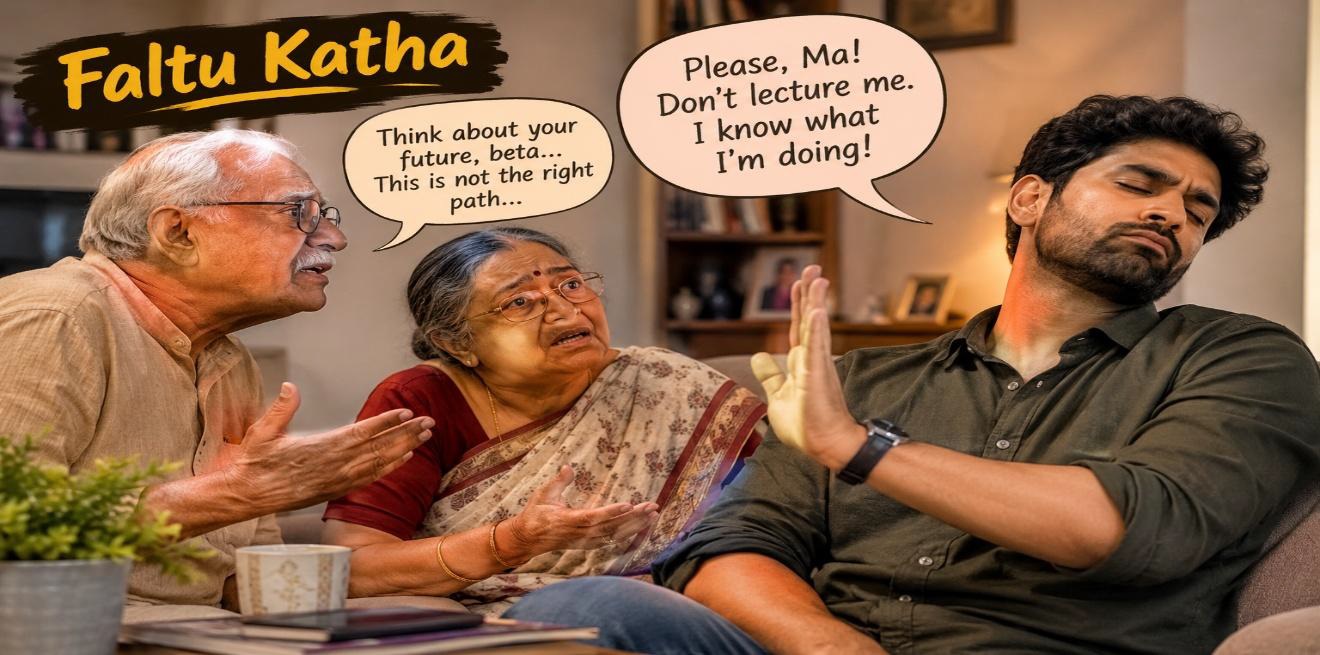

Language is rarely innocent. Some words communicate more than their literal meanings; they carry attitudes, hierarchies, prejudices, and sometimes an entire history of relationships. Faltu is one such word. In ordinary usage, it signifies something meaningless, trivial, useless, unnecessary, or unworthy of attention. Katha, on the other hand, is considerably more expansive.
It encompasses stories, conversations, advice, suggestions, recollections, and the informal exchanges through which human relationships sustain themselves. Together, Faltu Katha becomes an expression of dismissal. It does not merely question the relevance of what is being said, it can also diminish the worth of the person saying it. What makes the expression particularly disturbing is the possibility that a lifetime of experience, affection, and responsibility can eventually be reduced to something inconsequential.
The expression acquires its deepest irony within the parent-child relationship. Childhood is the period when parental words exercise their greatest authority. A child learns to walk by holding a parent’s hand, acquires language through parental interaction, understands social behaviour through observation, and gradually develops a sense of right and wrong. Parents become the child’s first educators, interpreters of the world, and the most dependable source of security.
However, human relationships are not static. The child grows, acquires education, develops independent opinions, and gradually tries to find an identity distinct from the parental one. This transition is both necessary and desirable. The problem begins when intellectual and material independence is accompanied by an assumption that parental experience has become intellectually redundant. The authority once accepted without question is now challenged, sometimes with reason, but increasingly without consideration. Advice is interpreted as interference, concern as control, and recollection as an unnecessary return to the past. The vocabulary of intimacy undergoes a subtle transformation: what was once guidance becomes preaching; affection becomes intrusion; and Katha becomes Faltu Katha.
This transformation raises a fundamental question: when does experience lose its value, and who has the authority to declare it irrelevant? Modern societies privilege knowledge that is immediate, measurable, and professionally acquired, and age no longer automatically commands respect. Neither generation holds a monopoly over wisdom. Yet the assumption that contemporary knowledge makes inherited experience obsolete is equally problematic.
The conflict, therefore, lies in diverse ways of knowing and interpreting life. A parent’s suggestion may not always be applicable to contemporary circumstances, but it emerges from an understanding of human behaviour that cannot be acquired through formal education alone. Equally, the younger generation may possess insights that their parents might lack, but that does not take away the wisdom of experience. The ideal relationship should accommodate this reciprocal exchange. Unfortunately, communication often becomes a contest of authority rather than an encounter between experiences.
There is also a psychological dimension to the expression. Younger generations are now more restless and eccentric and lack the patience to listen. For parents, the transition from being indispensable to becoming unnecessary can be profoundly unsettling. Their identities have often been shaped by years of responsibility towards their children. They spent the prime of their lives around education, security, employment, marriage, and the many uncertainties of their children’s futures. Much of this labour remains invisible precisely because it is performed within the ordinary routines of family life. Those are understood as responsibilities arising from affection. Yet, when the same parent eventually seeks a little participation in the adult child’s life, even a few minutes of patient listening may appear to be an unreasonable demand.
The injury caused by Faltu Katha is therefore not necessarily about disagreement. It is about the way disagreement is communicated. One can reject advice without humiliating its source or can disagree with an opinion in a dignified denial. Therefore, the distinction between intellectual independence and interpersonal discourtesy is essential. Growing up should enable individuals to negotiate relationships with greater maturity, not merely equip them with the confidence to dismiss others.
Equally important is the changing emotional economy of ageing parents. Retirement, declining social participation, physical limitations, and the dispersal of children often alter the elderly person’s relationship with the world. Professional identities recede, familiar social structures weaken, and the domestic sphere may become the principal site of emotional engagement. Conversations, anecdotes, repeated questions, and unsolicited suggestions acquire a significance beyond their immediate content. They are also ways of remaining involved, of establishing continuity with a world that is changing around them. What appears to the younger listener as repetition may represent the older person’s effort to preserve connection.
Memory occupies a particularly significant place in this relationship. Parents often narrate the past because recollection is one way of transmitting identity. Family histories, accounts of hardship, stories of migration, financial struggles, personal failures, and social transformations constitute an informal archive of experience. Such narratives connect generations and provide younger members with a sense of their own historical groundings. When these stories are dismissed as irrelevant, something more than a conversation is lost. An entire dimension of familial memory risks a disappearance. The younger generation may inherit the material advantages created by the preceding generation but without acquiring an adequate understanding of the history that made those advantages possible.
The argument here is not about an unquestioning defence of parental authority. Parents can be unreasonable, excessively controlling, emotionally manipulative, or unwilling to recognise the autonomy of their adult children. However, advice must not be conflated with coercion; ultimately, it is the recipient’s choice. Children are equally entitled to establish boundaries, disagree with inherited values, and build lives that differ from those their parents envisioned for them. Gratitude cannot be demanded as a substitute for mutual respect, nor should parental sacrifice be romanticised to the extent that it becomes a justification for expecting lifelong obedience. Respect for parents and the autonomy of adult children are not mutually exclusive; a healthy relationship must make room for both.
The most revealing feature of Faltu Katha is its casualness. It is often uttered without the deliberation associated with an insult. A moment of irritation, a hurried response, or a desire to end a conversation may produce it. But language has consequences beyond the speaker’s immediate intention. For the recipient, the expression may signify that their presence is tolerated but their thoughts are not valued. The parent may choose not to respond, because articulating that injury may expose an even greater vulnerability: the fear of becoming emotionally irrelevant to one’s own children.
There will eventually come a time when the familiar conversations shall cease to disturb, and the rest will remain as the memory of the advice itself, but the absence of the voice that offered it. Perhaps, then, Faltu Katha will be revisited. Then every story or advice shall appear profound. Human relationships cannot be evaluated exclusively through the immediate utility of words. Some conversations exist simply because people wish to remain present in one another’s lives. Therefore, the ultimate measure of maturity may lie in whether we can recognise our parents’ humanity when they cease to be indispensable to us. After all, what we sometimes dismiss as Faltu Katha may be the last remaining language through which a generation tries to tell another: I am still here, I still care, and I still wish to be heard.
Dr. Sachidananda Panda
School of Liberal Arts,
XIM University, Bhubaneswar