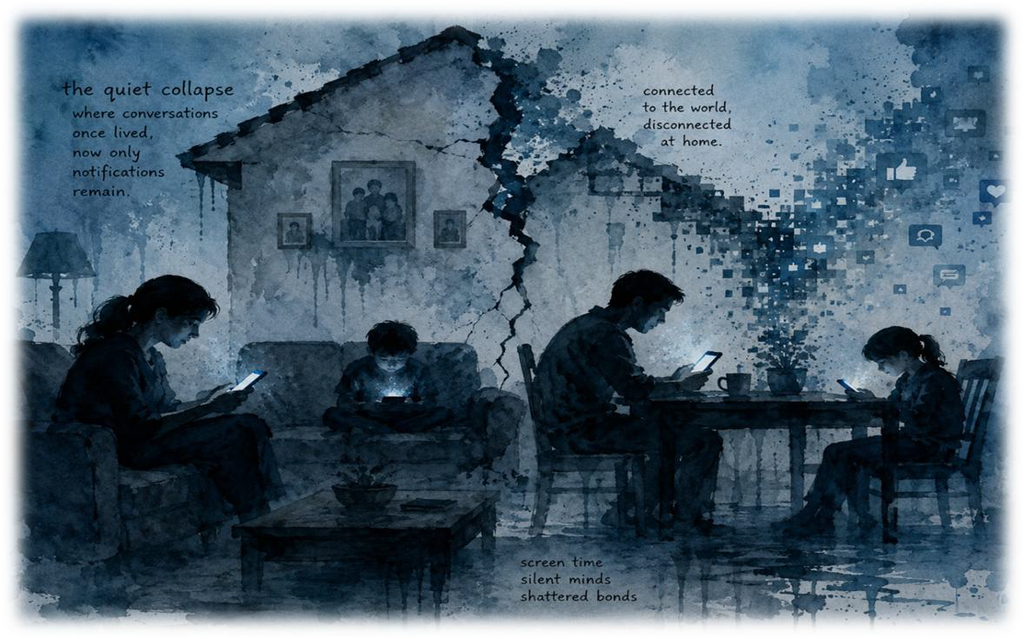


One of the quietest tragedies of modern life is that people are increasingly alone inside their own homes. The family still occupies the same physical space, yet its members often live in separate mental worlds, each enclosed within the glow of a personal screen.
The mobile phone, once introduced as a tool of connection, has gradually become the most constant companion of domestic life, filling silence, absorbing attention, and replacing conversation with endless distraction. In many homes, parents and children no longer drift apart because of open conflict or dramatic fracture, but because daily life has become so centrifugally busy that everyone is pulled outward at once. Work, school, notifications, errands, deadlines, and digital entertainment scatter the family in different directions, and togetherness survives only as proximity without presence.
The modern household is full of devices but short on shared attention. At dinner, one parent checks email, a teenager replies to messages between bites, and a younger child eats while watching videos. In the car, each person wears earphones. Before sleep, family members retreat to separate screens instead of conversation. Research now describes this pattern as technoference: the intrusion of devices into human relationships. A 2025 meta-analysis in JAMA Paediatrics found that parental technology use in a child’s presence was associated with poorer cognition, weaker prosocial behaviour, lower attachment, and more emotional and behavioural difficulties in young children, including inward struggles such as anxiety or withdrawal and outward behaviours such as aggression or defiance. Another 2025 study found that repeated smartphone interruption during parent-child conversations can leave children feeling ignored, sad, and less likely to seek attention again.
What is being lost is not only conversation but play, and with play a whole structure of intimacy. Families do not become close merely by solving practical problems together. They become close through laughter, boredom, shared nonsense, invented rituals, and the kind of purposeless time in which trust quietly grows. Yet contemporary life leaves little room for such unproductive joy. When families stop playing together, they do not simply lose amusement; they lose one of the deepest languages of love. Many homes now contain a quiet form of isolation. A child returns from school and goes straight to a bedroom screen. A parent finishes office work at the kitchen table long after dinner. Weekends pass in the same house, but with everyone following a separate digital routine. People remain occupied, yet rarely available to one another. The home, which should have been a place of recognition, begins to function as a shared address rather than a shared life.
Recent studies on children and screens make this pattern harder to dismiss. A 2025 study published in Pediatric Research reported that smartphone use and problematic patterns of smartphone use among children and adolescents have risen in recent years, with noticeable consequences for their quality of life. The concern is not simply that devices entertain too much, but that they increasingly shape how discomfort is managed. Drawing on a large review of more than 292,000 children worldwide, the American Psychological Association described a reciprocal pattern: higher screen use is associated with greater socioemotional difficulty, and those difficulties can push children toward even more screen use. In such a cycle, the family loses one of its oldest functions the ability to absorb distress through presence, conversation, and play because the screen becomes the first refuge rather than the last. Its effects show up quietly but unmistakably. Children become less likely to confide in parents who are physically present but mentally elsewhere. Parents may know routines, passwords, and school results, yet remain unaware of their children’s fears, friendships, and private disappointments. Even leisure becomes fragmented: one person scrolls, another streams, and someone else chats online. Over time, this separation no longer feels unusual. Loneliness becomes part of the household’s ordinary rhythm.
The family still functions, but its emotional centre weakens. Yet this condition is not beyond repair. The purpose here is not bat for the rejection of technology but a recovery of deliberate presence. A home becomes human again when its members learn to protect small, repeatable forms of shared life: meals without phones, evenings that include talk rather than parallel scrolling, walks, games, stories, idleness, and the rediscovery of play as something necessary rather than childish. In an age that measures value through productivity and constant availability, play may be one of the last defences of intimacy. If the family is to remain a living centre rather than an arrangement of isolated individuals, it must reclaim the time to be useless together. Otherwise, we may continue living under one roof while becoming strangers in the very place that was meant to shelter us from loneliness. A home is not merely built; it is made, and coloured, with compassion, care, and presence.
Dr. Sachidananda Panda
School of Liberal Arts
XIM University, Bhubaneswar