


Anne Carson’s The Beauty of the Husband: A Fictional Essay in 29 Tangos rigorously interrogates the romanticized institution of marriage, stripping it of its conventional moral sanctity. In “Tango II,” Carson dismantles the traditional marital myth which posits marriage as a sanctuary of mutual trust, fidelity, and shared truth by reframing it as a site of aesthetic captivity and intellectual violation.
By contrasting classical mythological ideals of loyalty with the stark, treacherous reality of her modern husband, the narrator exposes the fatal flaw in John Keats’s romantic assertion that beauty and truth are inherently aligned. Through a connected textual analysis of “Tango II,” this essay argues that Carson subverts the marital myth by presenting beauty not as a reflection of moral goodness, but as an intoxicating, coercive force that weaponizes intimacy and rationalizes betrayal.
The subversion of marital sanctity in “Tango II” begins with an act of intellectual theft that violates the foundational trust of the partnership. The narrator opens the tango with a startling revelation: “You know I was married years ago and when he left my husband took my notebooks. / Wirebound notebooks”. In a conventional marriage, the domestic sphere is meant to be a space of safety and shared vulnerability. However, the husband’s appropriation of the wife’s notebooks signifies a profound invasion of her interiority and creative autonomy. He does not merely leave the marriage; he colonizes her intellectual property. This act establishes the husband as an opportunist who views his wife not as an equal partner in a sacred union, but as a resource to be plundered. The theft of the notebooks immediately disrupts the myth of domestic security, framing the husband’s departure as an act of calculated subjugation rather than a mere emotional failure.
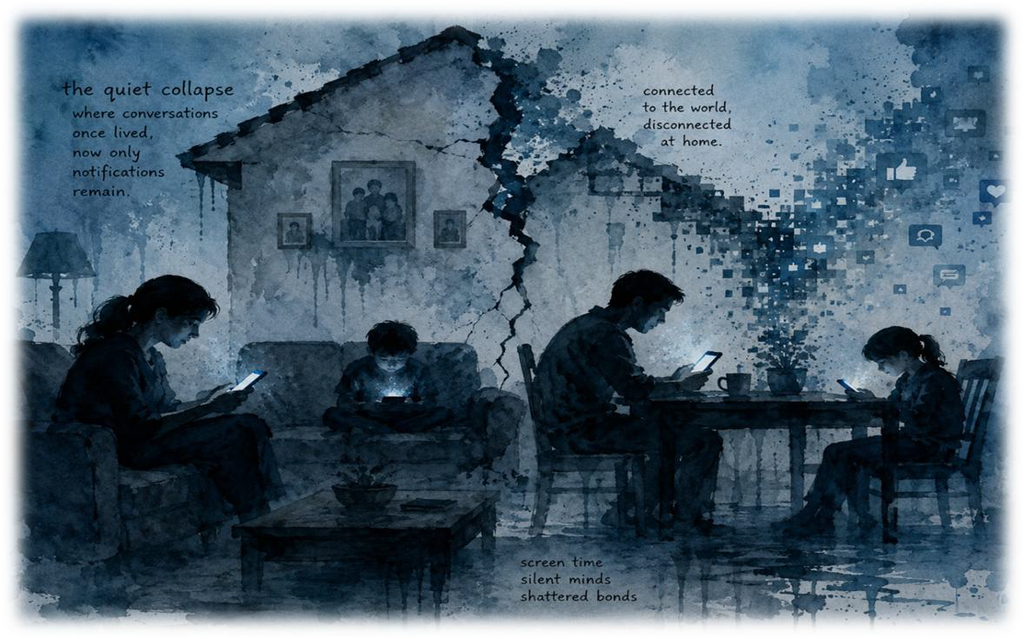
What is being lost is not only conversation but play, and with play a whole structure of intimacy. Families do not become close merely by solving practical problems together. They become close through laughter, boredom, shared nonsense, invented rituals, and the kind of purposeless time in which trust quietly grows. Yet contemporary life leaves little room for such unproductive joy. When families stop playing together, they do not simply lose amusement; they lose one of the deepest languages of love. Many homes now contain a quiet form of isolation. A child returns from school and goes straight to a bedroom screen. A parent finishes office work at the kitchen table long after dinner. Weekends pass in the same house, but with everyone following a separate digital routine. People remain occupied, yet rarely available to one another. The home, which should have been a place of recognition, begins to function as a shared address rather than a shared life.
To amplify the tragedy of this betrayal, Carson juxtaposes her reality against classical mythological archetypes of marital devotion. She invokes the Homeric figure of Andromache, who, grieving for Hector, returns “down from Troy’s tower and through stone streets to her loyal husband’s / house”. In the Greek epic tradition, Hector represents the paragon of civic and domestic duty, a husband whose loyalty commands eternal mourning and respect. Carson violently severs this connection in the subsequent lines, declaring abruptly: “Loyal to nothing / my husband”. By positioning her own marriage against the epic loyalty of Hector and Andromache, Carson highlights the profound moral vacuum of her husband. The mythic reference serves as a structural foil; while Andromache’s marriage is defined by honourable tragedy and steadfast devotion, the narrator’s marriage is characterized by a petty, destructive treachery that renders the very concept of marital loyalty absurd.
Despite recognizing this absolute lack of loyalty, the narrator remains inextricably bound to the husband, trapped not by marital duty, but by the sheer, overpowering force of his physical form. When questioning her own subjugation “So why did I love him from early girlhood to late middle age / and the divorce decree came in the mail?” she answers with devastating simplicity: “Beauty. / No great secret. / Not ashamed to say I loved him for his beauty”. Here, the marital myth is entirely decoupled from goodness, ethics, or shared values. Carson introduces the central thesis of the husband’s power: “Beauty convinces”. His beauty operates as an excusatory mechanism, blinding the narrator to his moral bankruptcy. The aesthetic appeal of the husband becomes a form of tyranny, holding the wife captive in a relationship where she is a willing victim to a beautiful facade that masks an empty, self-serving core.
The adversarial nature of this marital dynamic is further solidified through the husband’s obsessive emotional detachment, framing their union as a tactical conflict rather than a partnership. The husband channels his passion not into the marriage, but into simulated warfare. The narrator bitterly notes, “All in all my husband was a man who knew more / about the Battle of Borodino / than he did about his own wife’s body, much more!”. The historical Battle of Borodino, a notoriously bloody and Pyrrhic conflict, serves as a metaphor for the marriage itself. The husband is intimately familiar with the mechanics of war and strategic manoeuvring yet fundamentally alienated from the vulnerability of marital intimacy. The marriage bed is replaced by the war game board, rendering the relationship a theatre of masculine ego and emotional neglect.
Ultimately, “Tango II” functions as a devastating critique of the romantic illusions that sustain the marital myth. Through her precise use of classical juxtaposition, stark imagery, and the relentless logic of aesthetic power, Carson reveals marriage not as a sanctuary, but as a site of theft, emotional starvation, and war. The husband’s beauty does not represent truth; it represents a coercive force that normalizes betrayal, leaving the narrator bound to a man loyal to nothing but his own destructive conquests. Carson’s writing, both in prose and poetry, often features succinct statements, surprising analogies, and sudden changes in direction. A scholarly excerpt might transition into a poignant recollection, while a serious discussion could incorporate subtle humour. Everyday language often coexists with precise literary references. Her tone fluctuates between restraint, tenderness, irony, and unexpectedness. Emotional depth is frequently conveyed through imagery rather than direct explanation, and that makes a Nobel.
Dr. Sachidananda Panda
School of Liberal Arts
XIM University, Bhubaneswar