

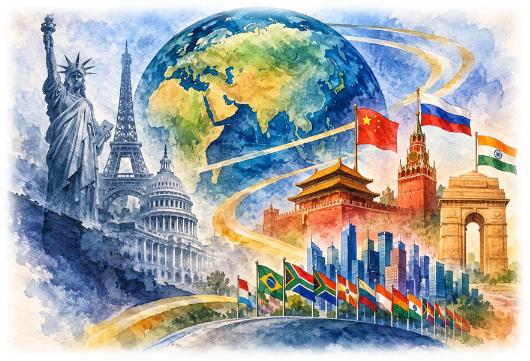

A new world order is first emerging, and it is intriguing to see gross adjustments in every sector. The old walls are falling apart, and the new framework is fast catching up; the gap is being filled by emerging power centres that once toed the line of US-led world order.
The new international order should not be seen as the decline of the West but rather as a greater spread of economic capacity, technical reach, and diplomatic influence. This change is significant because it represents the end of an era when international affairs were dominated by a small group of Western governments.
The historical basis of Western primacy explains why this development is significant. Industrialisation, which began with coal and steam, provided European countries an advantage in production, transportation, and military organisation. Colonial expansion intensified these advantages, and the United States eventually became a major economic and strategic power. However, industrial leadership was never a permanent right. In due course, as education, infrastructure, manufacturing, and scientific understanding expanded, the conditions that favoured concentrated power became less exclusive. The shift reflects the distribution of capabilities rather than the displacement of one dominant country by another. Now BRICS is the new reality and offers a credible platform, a framework for this redistribution. The alliance, which originally comprised Brazil, Russia, India, China, and South Africa, has since extended beyond its core membership.
In January 2025, Brazil announced Indonesia’s full membership in BRICS, marking a milestone in developing-country participation and efforts to reform global governance. Indonesia’s admission illustrates how emerging economies are seeking new channels of influence. Its significance lies not in claiming victory over the G7 but in showing that international bargaining increasingly involves multiple centres of economic and political power. These dimensions of power operate across different domains: purchasing power parity(ppp) measures domestic economic capacity, while exchange-rate-based metrics capture a country’s international financial reach.
Population, industrial output, military capability, and currency influence are some of the other distinct dimensions. Therefore, GDP and population shares should not be treated as interchangeable evidence of geopolitical supremacy. The central argument is that growing productive capacity provides emerging economies greater leverage, but political cohesion determines whether they can translate that leverage into effective collective action.
Technology accelerates this shift because it depends on who can develop and distribute essential systems. Two Asian giants, India and China, are now focusing on clean energy innovation, which is considered a major contribution to global sustainability rather than merely a strategic challenge. Evidence supports the scale of the transformation: the International Energy Agency reports that China sold well over eleven million electric cars in 2024, accounting for almost half its car sales. The core BRICS bloc commands roughly 44.69 million annual vehicle sales—nearly 45% of the entire 99.80 million global automotive market. Other sectors like renewable energy and clean energy the focus shifts to BRICS as India is also advancing the clean-energy transition through expanding solar and wind capacity. Its rooftop solar programme now has become the centre of attraction that brings renewable power directly to households. Beyond its borders, India co-founded the International Solar Alliance with France to promote solar cooperation and wider energy access. Its National Green Hydrogen Mission aims to extend this momentum to cleaner industrial production and reduce dependence on fossil fuel imports. This pattern shows why technological leadership cannot be assumed to remain geographically fixed.
However, technological success does not automatically create a cooperative order. Countries can welcome affordable clean technologies while worrying about dependence on concentrated suppliers. Therefore, the relevant policy challenge is to combine access with resilience: diversifying production, developing local skills, and establishing transparent standards without turning every commercial relationship into a security confrontation. Because sustainability holds the key and sits at the centre of the new order and climate stability, resource stewardship, as well as protection of the entire ecosystem are shared requirements. Secondly, the inclusion of African Union’s to the G20 at the 2023 New Delhi summit asserts that broader representation can emerge through the adaptation of existing institutions. This exemplifies multipolarity that is different from a simple division between the West and the rest, and participation in one forum seldom exclude cooperation in another provided it remains focused on trade, infrastructure, finance, and climate action.
A fairer world should therefore be treated as a possibility, though not a guaranteed outcome. These emerging centres of power can restrain unilateral domination. The clear distinction is between multipolarity as a distribution of capabilities and multilateralism as a method of governing their interaction. Peace in the world is possible only when a rule-based order is adhered to, and respect for sovereignty, credible institutions, and mechanisms for managing disputes are at place. The so-called powerful states of yesteryears alone cannot supply these safeguards. The changing world order consequently presents a choice before us rather than a predetermined destination. Established powers can accommodate wider participation, while rising powers can pursue reform without reproducing domination. A durable new order therefore should combine representation with responsibility, technological advancement with sustainability, and national autonomy with shared rules. However, its success would certainly be judged by whether it complicates or consolidates the security and opportunity for ordinary people.
Dr. Sachidananda Panda
School of Liberal Arts,
XIM University, Bhubaneswar